Native MSIX and App Attach solve different delivery problems for Azure Virtual Desktop and Windows 365. Here is how to choose the lowest-complexity model for your requirement.
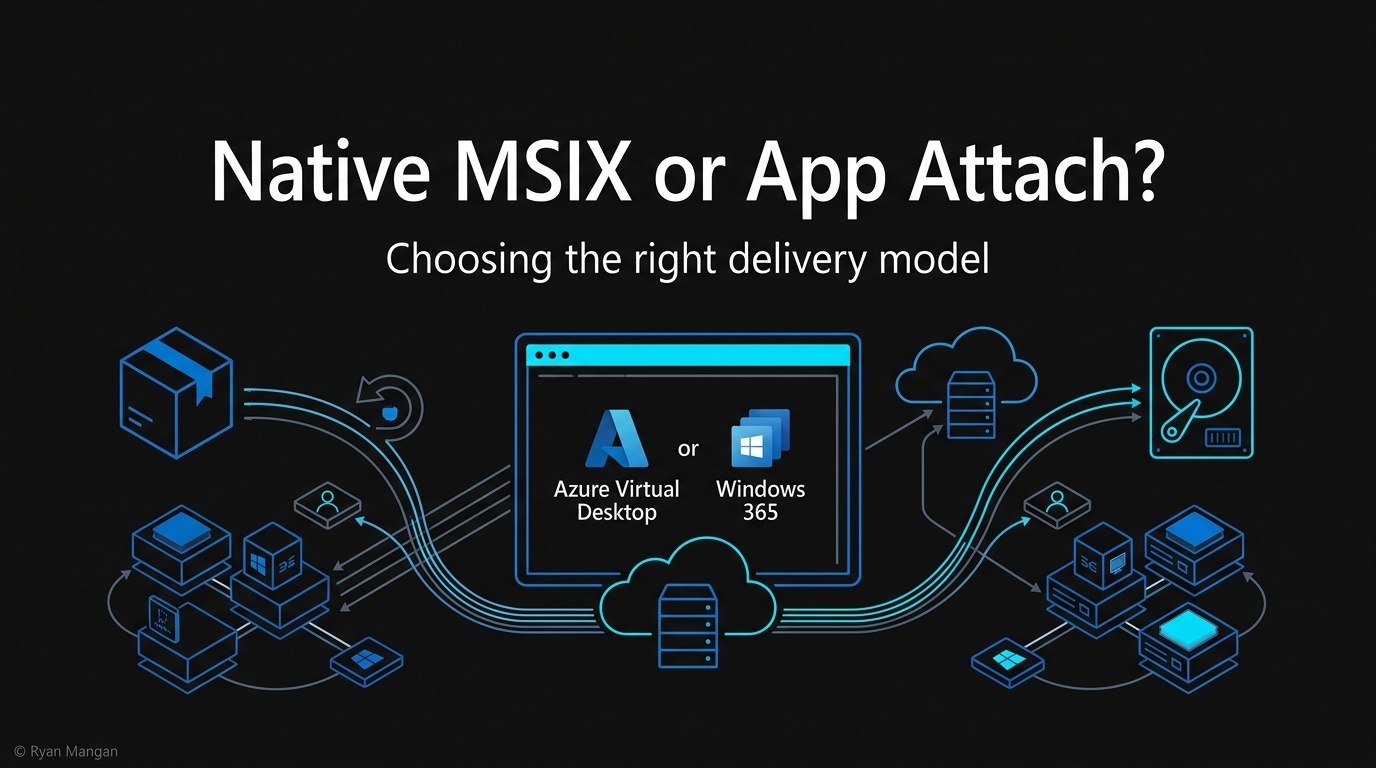
The question I keep seeing is simple: should we use native MSIX or App Attach for virtual desktop application delivery?
The answer is less simple, because the two options are often compared as if they solve the same problem. They do overlap, but they are not the same operating model.
Native MSIX is primarily a package delivery model. App Attach is an image-based application delivery and assignment model for Azure Virtual Desktop. That difference matters when you are designing for Azure Virtual Desktop, Windows 365, or any environment where image management, user assignment, rollback, and operational risk are part of the architecture.
Why this decision matters
In smaller or simpler estates, native MSIX can be the lower-complexity choice. If an application can be installed for the current user, provisioned for current and future users, included in a managed image, deployed through endpoint management, or handled through a desired-state process, then App Attach may add moving parts without adding enough value.
In larger VDI estates, the problem often shifts. The question becomes less about installing a package and more about keeping applications out of the base image, assigning different application sets to different users, reusing application images across host pools, and rolling forward or back without rebuilding every session-host image.
That is where App Attach starts to make sense.
The core difference
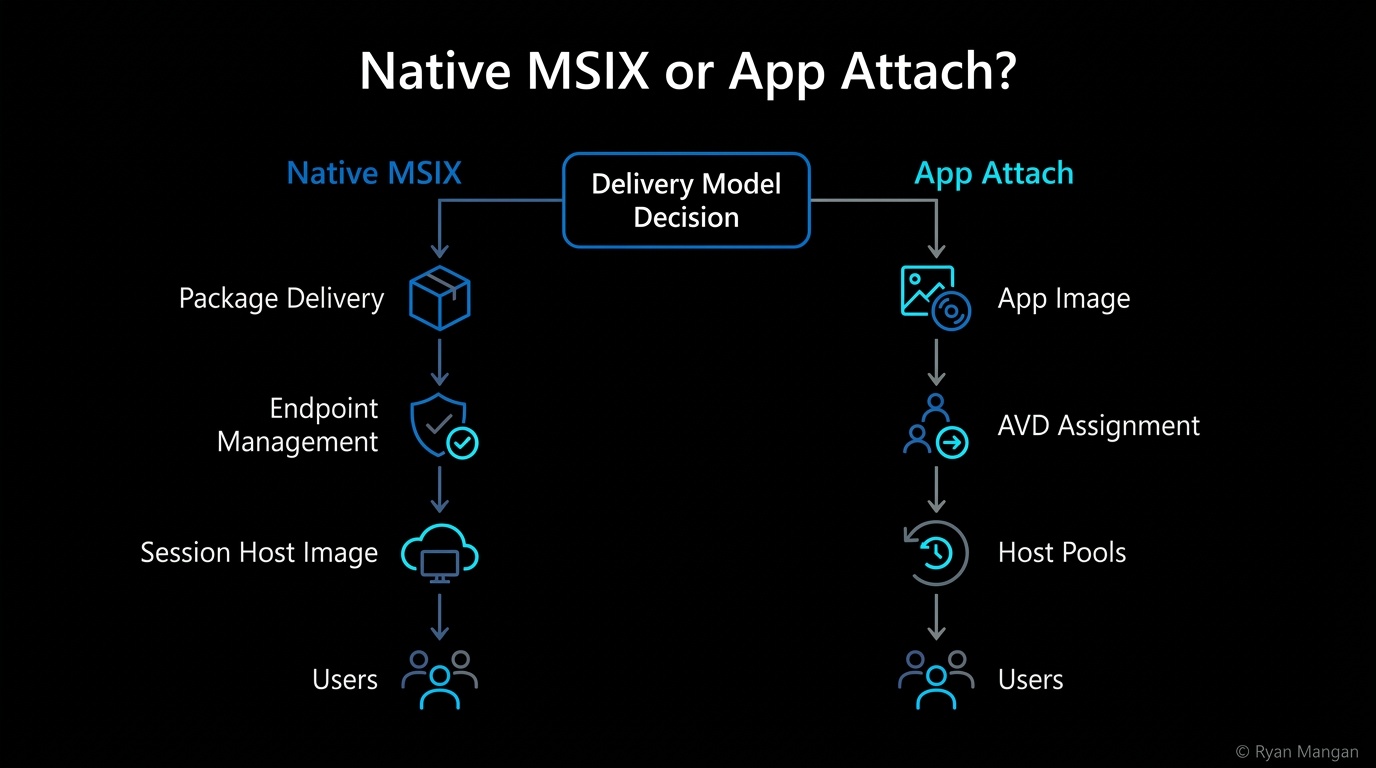
Native MSIX works well when the delivery requirement is package-centric.
Typical examples include:
- current-user app installation
- provisioned app availability for common applications
- image-baked application baselines
- endpoint-managed deployment through existing tooling
- version rollout and rollback through a native control process
App Attach works well when the requirement is assignment-centric and image-centric.
Typical examples include:
- applications kept outside the session-host image
- user or group assignment through Azure Virtual Desktop
- application reuse across multiple host pools
- image-level promotion and rollback
- concurrent application versions assigned through the AVD management plane
This is why I do not see the decision as "which one is faster?" That framing misses the operational point.
What the recent paper found
In my recent research paper, Native MSIX or App Attach for Azure Virtual Desktop?, I compared the two approaches from a decision-oriented perspective: package delivery, assignment, image management, lifecycle behaviour, cleanup, storage, ACLs, RBAC, endpoint security, and operational risk.
The evidence supports a practical rule: choose the lowest-complexity delivery model that satisfies the requirement, then validate it on the actual package set and platform.
The timing results were intentionally bounded. They used one signed probe package, one Windows 11 host, local lifecycle measurements, Azure Files supportability checks, and disposable Azure Virtual Desktop pilots. The paper does not claim to be a general benchmark.
That point is important. App Attach recorded lower repeated delivery-lifecycle medians in the measured local case, but already-installed native MSIX and already-staged App Attach VHDX had similar steady-state launch behaviour. That means launch speed alone should not drive the architecture decision.
Where Windows 365 fits
Windows 365 changes the operational context, but not the core decision logic.
If the Cloud PC model is relatively standardized and applications are common across most users, native MSIX, endpoint management, or image-based delivery through existing management tools may be enough.
If the requirement starts to look more like pooled or segmented application assignment, with different groups needing different application sets and faster rollback, then the App Attach operating model becomes more relevant, especially where Azure Virtual Desktop is part of the wider platform design.
In both cases, the architectural question is the same: do I need image externalisation and managed assignment, or is native package lifecycle management sufficient?
The practitioner takeaway
Native MSIX should be the default starting point when the requirement is simple application delivery.
App Attach should be justified when it solves a real operational problem: fewer image rebuilds, cleaner host-pool reuse, group-based entitlement, central image promotion, rollback control, or keeping the application payload outside the base image.
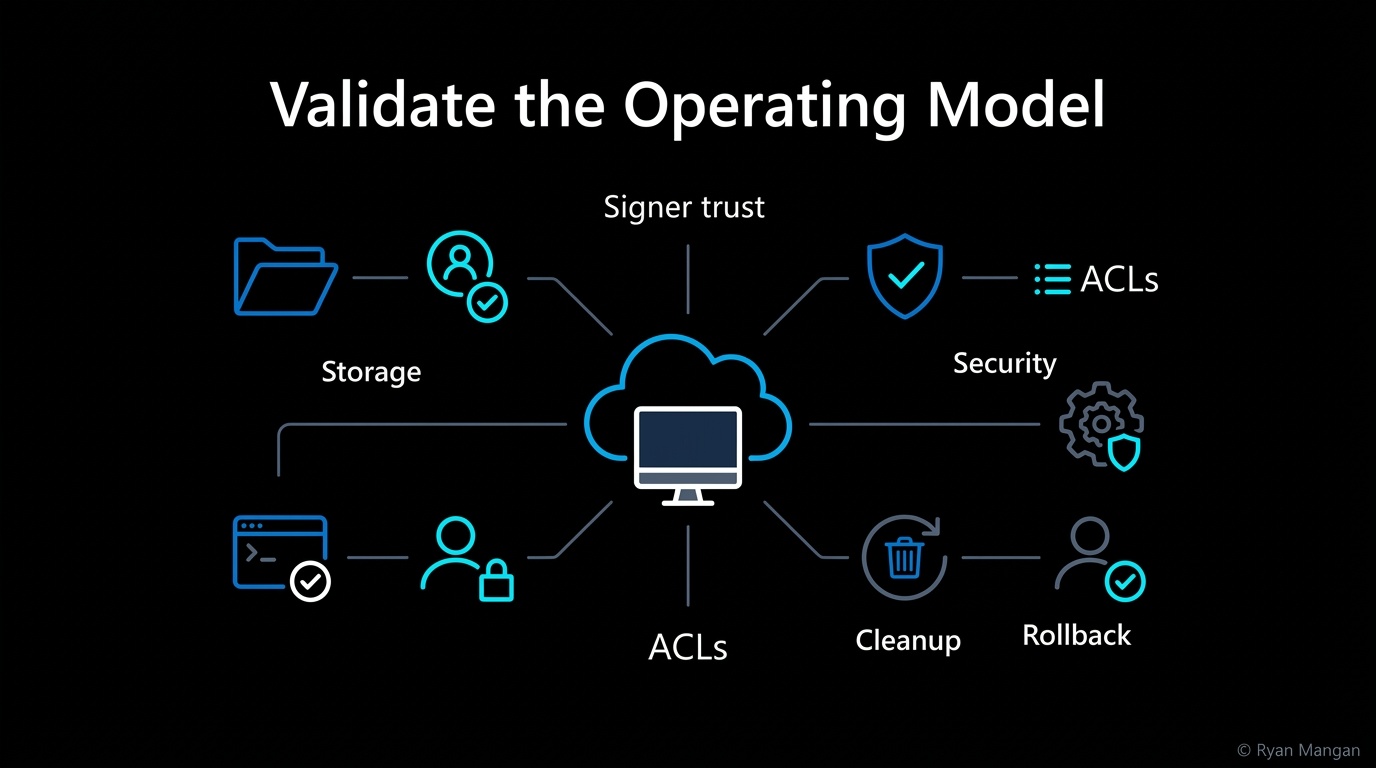
The cost of App Attach is also real. You need to validate storage paths, CimFS or VHDX handling, signer trust, RBAC, ACLs, endpoint security behaviour, cleanup, post-reboot behaviour, and AVD assignment. A launch test alone is not enough.
📄 Read the full preprint (open access, CC BY 4.0): Native MSIX or App Attach for Azure Virtual Desktop?
References
- Native MSIX or App Attach for Azure Virtual Desktop? (Zenodo, DOI)
- App Attach in Azure Virtual Desktop - Microsoft Learn
- Add and manage App Attach applications in Azure Virtual Desktop - Microsoft Learn
- Test MSIX packages for App Attach - Microsoft Learn
- App package updates - Microsoft Learn
- Preinstalling packaged apps - Microsoft Learn